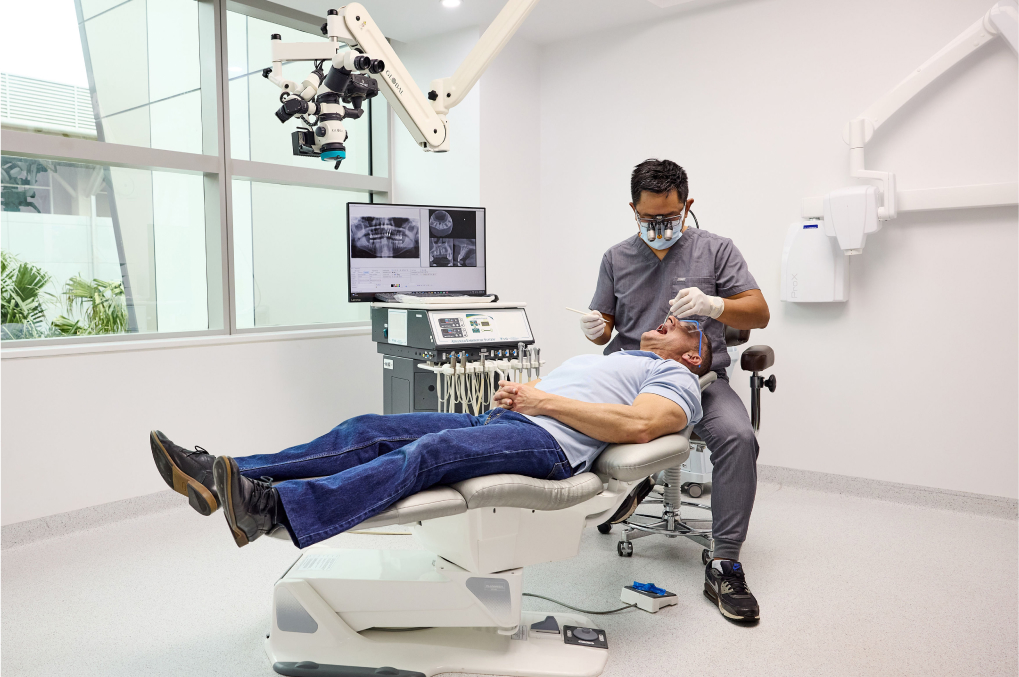
A root canal is a six-stage procedure, typically completed in 60 to 90 minutes, that removes infected pulp tissue and saves the natural tooth. With modern anaesthesia, you feel pressure and vibration but not pain during treatment. Around 96% of patients who have had a root canal say they would consent to the procedure again if needed. This guide focuses on what each stage actually feels like, for anyone whose main question is not “what happens” but “will it hurt.”
Anxiety about root canal treatment almost always comes from uncertainty about what will happen, more specifically what it will feel like. Modern endodontics combines precise local anaesthesia, microscope-assisted visualisation, and refined instrumentation that makes the appointment quieter, faster, and more comfortable than most patients imagine. For a full breakdown of the clinical steps involved, see our main guide to root canal treatment. This guide walks through the same six stages with a specific focus on sensation: what you will feel, when, and for how long.
A root canal is an endodontic procedure that removes infected or damaged pulp tissue from inside a tooth, cleans and disinfects the root canal system, and seals the tooth to prevent reinfection.
Your tooth has three main layers: the hard outer enamel sits over the dentine, and the soft inner pulp contains the nerves, blood vessels, and connective tissue. When bacteria penetrate the pulp through deep decay, a crack, or trauma, infection develops inside a confined space where your immune system cannot reach it. Without treatment, the infection spreads to surrounding bone and forms an abscess. Root canal treatment removes the infected tissue and seals the canal system. With an appropriate crown, the treated tooth can stay functional for 10 to 20 years or more.
Source: Healthdirect, 2024
Most root canal appointments run between 60 and 90 minutes. The exact duration depends on the tooth type and the number of canals involved.
| Tooth Type | Typical Single-Visit Duration |
| Front tooth (1 canal) | 45 to 60 minutes |
| Premolar (1 to 2 canals) | 60 to 75 minutes |
| Molar (2 to 3 canals) | 75 to 120 minutes |
Source: AAE, Root Canals Explained, 2024
Single-visit versus multi-visit treatment
At Australian Dental Specialists, Dr Varayini Yoganathan completes most root canal treatments in a single visit, including complex cases with curved canals or extensive infection. Published meta-analyses show no significant difference in long-term success rates between single-visit and multi-visit approaches. Multi-visit treatment is reserved for cases where the tooth is severely damaged or the infection requires staged management. Dr Varayini will discuss whether a single or staged approach suits your case at your consultation.
The sections below summarise each stage briefly. For the full clinical detail of each step, see our complete root canal treatment guide.
Stage 1: Diagnosis and consultation — no sensation, this stage is non-invasive
A typical diagnostic appointment includes a clinical examination of your symptoms, bite, and the affected tooth, vitality testing using cold and electric pulp tests, periapical X-rays, and, for complex cases, CBCT imaging. At the end, your endodontist presents a clear treatment plan, explains the number of canals involved, the likely appointment time, and whether a single-visit or two-visit approach is most appropriate.
Stage 2: Anaesthesia and isolation — a brief pinch, then nothing
A numbing gel is applied to the gum at the injection site for 30 to 60 seconds before the needle is placed. Most patients report barely feeling the injection itself. Buffered anaesthetic solutions, which adjust pH for faster onset and reduced injection discomfort, are now widely available.
Your endodontist will confirm complete numbness before proceeding. If you feel anything more than pressure during treatment, raise your hand and additional anaesthetic is administered immediately. Once numb, a rubber dam (a thin sheet of latex or latex-free material held by a small clamp) isolates the tooth from saliva and keeps the working field clean and dry. You may feel brief pressure from the clamp as it is placed.
Source: Australian Prescriber, Management of Dental Pain in Primary Care, 2020. AAE, Root Canals Explained, 2024
Stage 3: Access and removal of infected pulp — pressure and vibration, not pain
Your endodontist creates a small opening through the crown of the tooth to access the pulp chamber and root canals beneath. Initial pulp removal typically takes 20 to 30 minutes. The opening is kept as conservative as possible to preserve tooth structure. Infected, dead, or dying pulp tissue is removed using small hand instruments and ultrasonic tips; this tissue has no capacity to heal once bacteria have invaded it.
Your endodontist uses magnification, typically a dental operating microscope, to locate all canals within the tooth, since some teeth have more canals than standard anatomy suggests. With effective anaesthesia, this stage involves pressure and vibration but not pain. You may hear the drill and the suction. Some patients find it helpful to focus on steady breathing or listen to music through headphones.
Stage 4: Shaping and disinfection — the longest stage, mostly vibration
This is the most technically demanding stage for your specialist, though not the most uncomfortable for you. Flexible nickel-titanium rotary files progressively shape each canal from its opening to the apex. An electronic apex locator, confirmed by X-ray, establishes the precise length of each canal.
Throughout shaping, the canals are continuously flushed with irrigation solutions: sodium hypochlorite dissolves organic tissue and kills bacteria, and EDTA solution removes the smear layer left by instrumentation. In many cases, irrigants are activated using ultrasonic energy to improve penetration into fins, webs, and lateral canals. At Australian Dental Specialists, the operating microscope is used throughout this stage, allowing your endodontist to see and treat anatomical variations invisible to the naked eye. Pressure, vibration, and occasionally a faint taste from irrigation are normal; pain is not.
Source: Australian Endodontic Journal, 2024
Stage 5: Filling and sealing the canal system — mild pressure, occasional warmth
Once the canals are confirmed clean and dry, they are filled with gutta-percha, a biocompatible thermoplastic material that has been the standard endodontic filling material for over a century, alongside a sealer cement. Your endodontist compacts the material using gentle heat and pressure for complete three-dimensional filling, then seals the access cavity with a temporary or permanent restoration.
A good coronal seal is critical: even a perfectly filled root canal can fail if the tooth is not sealed correctly against saliva and bacteria. A periapical X-ray confirms the fill is complete and at the correct working length. You may notice a mild warming sensation if heated gutta-percha techniques are used; beyond that, this stage is straightforward and typically causes minimal discomfort.
Stage 6: Crown placement — similar to a routine filling
Root canal-treated teeth require a crown in most cases, as the access cavity preparation and removal of infected tissue reduce structural integrity. Molars and premolars are under significant chewing forces, and without a crown these teeth are at high risk of vertical fracture, which often means extraction.
Research published in the Australian Endodontic Journal found that teeth protected by a crown achieve a 93% long-term survival rate, compared with only 65% for uncrowned root canal-treated teeth. The presence of a crown is the single most influential factor in long-term tooth survival after root canal treatment. Crown placement typically occurs within two to four weeks of completing root canal treatment, once inflammation has settled and the tooth is confirmed stable. Anterior teeth with sufficient remaining structure may not always require a crown; your endodontist will advise based on your case.
Many patients are surprised to find their root canal appointment more manageable than anticipated. The table below brings together the realistic sensations at each stage, assuming effective anaesthesia is in place — this is the single most useful reference if your main concern is discomfort rather than procedure detail.
| Stage | Sensation You Will Feel |
| Anaesthetic injection | Mild pressure, brief dull sensation |
| Access preparation | Vibration, pressure, sound |
| Canal shaping | Vibration, occasional irrigation taste |
| Obturation (filling) | Mild pressure, slight warmth |
Once the anaesthetic wears off, typically 2 to 3 hours after treatment, mild to moderate soreness around the treated tooth is normal. Postoperative discomfort usually settles within 24 to 72 hours, with full comfort returning within one week. This is soft tissue inflammation from the procedure, not a sign that something went wrong.
Combined ibuprofen and paracetamol, taken as advised by your endodontist, is typically the first-line option for post-treatment discomfort and is more effective than either drug alone. Avoid aspirin, which increases bleeding risk. Biting on the tooth may feel different or slightly tender for a week or two as the periodontal ligament heals.
Contact us promptly if you experience severe pain persisting beyond three days, pain that returns after initial improvement, swelling developing days after treatment, fever, or if the temporary restoration falls out.
Source: Healthdirect Australia, Root Canal Treatment, 2024. Australian Prescriber, Management of Dental Pain in Primary Care, 2020
Will I need time off work?
Most patients return to work the same day or the following day. Avoid strenuous physical activity for 24 to 48 hours after treatment, as increased blood flow can intensify soreness. If your appointment requires sedation, you will need someone to drive you home and should not drive until the effects have fully worn off.
Can I drive after a root canal?
Yes, provided no sedation was used. Once the local anaesthetic has fully worn off, typically 2 to 3 hours after treatment, and you are not experiencing discomfort that affects your concentration, it is safe to drive. If conscious sedation was administered, you must arrange alternative transport for the remainder of the day.
Can I eat beforehand?
Yes, eat normally before your appointment. You will be unable to eat or drink on the side of your mouth with the treated tooth until the anaesthetic wears off. For the first 24 to 48 hours, soft foods are recommended: yoghurt, soup, smoothies, mashed potato, scrambled eggs, and well-cooked pasta. Avoid hard, crunchy, or sticky foods and chew on the opposite side until comfort returns.
Is there an alternative to a root canal?
The only alternative for a tooth with irreversible pulp infection is extraction. There is no natural remedy, antibiotic course, or home treatment that can eliminate an established pulp infection. If extraction is chosen, the space typically requires replacement with an implant or bridge to prevent adjacent teeth from shifting and bone loss at the extraction site. For most patients, root canal treatment combined with a crown is the more cost-effective and functionally superior long-term choice.
What is the success rate?
Root canal treatment has an overall survival rate of 86 to 93% at two or more years of follow-up, rising to 93% for teeth that receive a protective crown. Success is influenced by the presence of a crown (the most influential single factor), tooth type, the extent of pre-existing infection, and whether the tooth is used as a prosthesis abutment. Treatment performed by a specialist endodontist using microscopic techniques and advanced imaging supports optimal outcomes.
Does the procedure hurt?
With effective local anaesthesia, you should feel pressure and vibration but not pain during the procedure. Around 96% of patients who have had root canal treatment say they would consent to repeat treatment if needed.
At Australian Dental Specialists in Norwest, our endodontists take time before every appointment to walk through exactly what will happen, answer your questions, and ensure you feel informed and in control throughout. The sooner an infected tooth is assessed and treated, the simpler and more predictable the outcome.
Our endodontist Dr Varayini Yoganathan welcomes patients from across North West Sydney, the Hills District, Norwest Business Park, and Greater Sydney.
General educational information only. Individual treatment outcomes vary. Always consult a qualified dental practitioner about your specific circumstances.
We offer timely appointments to ensure you receive the care you need when you need it. From endodontics to periodontal therapy, our specialists manage every aspect of your dental health with expertise and comprehensive post-operative support.
Your smile is our priority—experience the difference with our specialist care today.
© 2026 Australian Dental Specialists | Privacy
Site by Luna Digital Marketing
