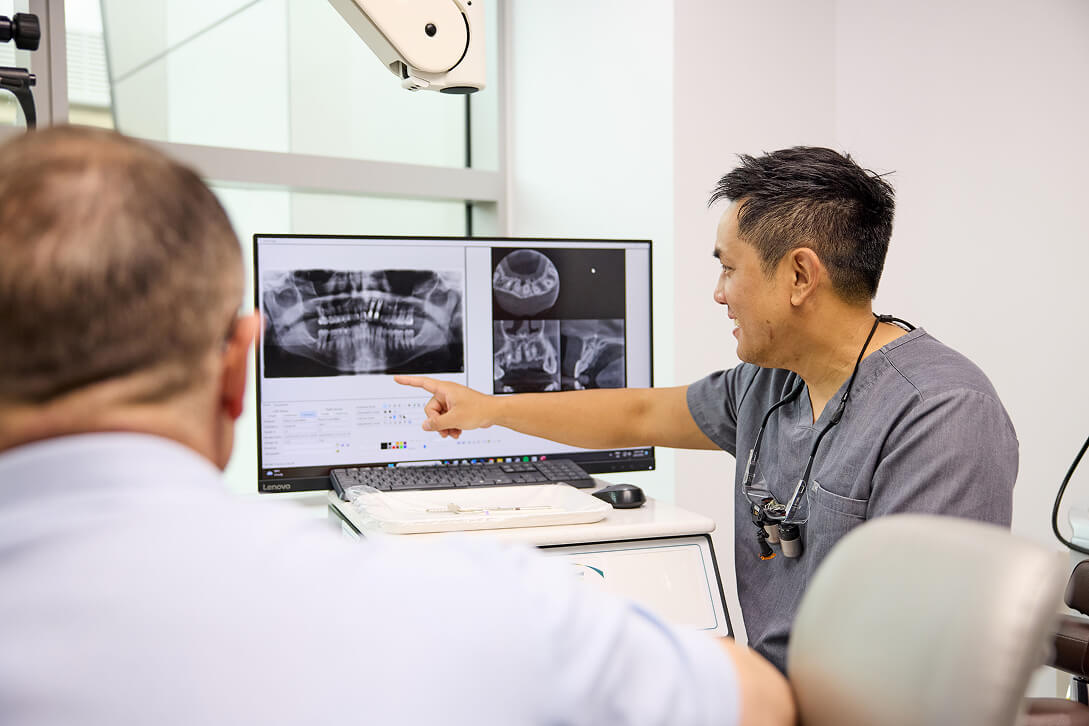
A root canal is the standard treatment for a cracked tooth when the fracture reaches the internal pulp or causes persistent inflammation. While cracks are notoriously difficult to see, specialists use high-magnification microscopes to determine if a tooth is salvageable or requires extraction.
Tooth enamel is the hardest substance in the human body, but it isn’t indestructible. Years of chewing, teeth grinding, or accidental trauma can cause structural fatigue. Unlike a broken bone, a cracked tooth will never heal. Instead, the fracture behaves more like a crack in a car windscreen. It starts small and gradually spreads under the constant pressure of daily use.
The primary danger of a crack is that it provides a direct pathway for bacteria to enter the sterile centre of your tooth. This area, known as the pulp, contains the nerves and blood vessels that keep the tooth alive. Once bacteria breach this space, an infection or painful inflammation becomes inevitable. Understanding how these cracks behave and how we treat them is essential for saving your natural smile.
One of the most frustrating aspects of a cracked tooth is that you might feel significant pain even when your tooth looks perfectly healthy. This is why cracked teeth are often referred to as “The Great Imposter” in dentistry. The symptoms often mimic other issues like sinus pressure, tooth sensitivity, or even gum disease.
Standard dental X-rays are a brilliant tool, but they have a significant limitation when it deals with cracks. An X-ray is a two-dimensional shadow of a three-dimensional object. For a crack to show up on an X-ray, the beam must be perfectly aligned with the fracture line. Since most cracks are thinner than a human hair and run vertically, they are rarely captured on film in the early stages.
This is where specialist endodontic care becomes vital. By using a dental operating microscope and small FOV CBCT (3D imaging) we can see the tooth’s structure in incredible detail. We can also use specialised dyes that seep into the fracture lines to make them visible under high-intensity light. If we can’t see the crack, we can’t treat it effectively.
Not all cracks are created equal. The treatment plan and the long-term outlook for your tooth depend entirely on which category the fracture falls into.
Almost every adult has craze lines. These are tiny, superficial cracks that only affect the outer enamel. They are common as we age and are generally considered a cosmetic issue rather than a functional threat. Craze lines do not cause pain and do not require root canal treatment.
The cusps are the pointed parts of your chewing surface. If a cusp becomes weakened, often by a large filling, it can eventually snap off. While this can be startling, it is often the least serious type of fracture. If the break stays above the gum line and doesn’t expose the pulp, a simple crown or onlay can fix the problem. However, if the break goes deep, a root canal might be necessary to remove damaged nerve tissue.
When dentists talk about a “cracked tooth,” they usually mean a vertical fracture that starts at the chewing surface and extends toward the root. The tooth hasn’t yet split into two pieces, but the segments move slightly when you bite down. This movement irritates the pulp and causes that classic sharp pain. If caught before it reaches the root, a root canal followed by a crown can successfully save this tooth.
If a cracked tooth is left untreated, it will eventually become a split tooth. This means the fracture has progressed so far that the tooth is now in two distinct, movable segments. In most cases, a split tooth cannot be saved in its entirety. While a specialist might be able to save a portion of the tooth through complex procedures, extraction is often the most predictable outcome.
These are perhaps the most difficult cases. These cracks start at the bottom of the root and move upward toward the chewing surface. They often show very few symptoms until the surrounding bone and gum tissue become infected. Because the fracture starts deep inside the bone, these teeth almost always require extraction.
When you visit a specialist endodontist, the diagnostic process is much more involved than a standard check-up. We use a combination of tactile tests, visual inspections, and advanced imaging to build a complete picture of the damage.
One common tool is the “bite test.” We ask you to bite down on a small plastic device on different parts of the tooth. If you feel a sharp pain upon releasing the pressure, it’s a strong indicator of a crack. We also perform “transillumination,” where we shine a powerful fibre-optic light through the tooth. A healthy tooth will glow uniformly, but a crack will block the light and create a visible shadow.
The most important tool in our arsenal is the 3D CBCT scan. This technology allows us to look at the tooth from every possible angle in three dimensions. It helps us identify bone loss patterns that are characteristic of specific types of cracks, allowing us to give you an honest assessment of whether a root canal is likely to succeed.
If we determine that the crack has affected the pulp but the tooth structure is still sound, we will recommend a root canal. The goal of this procedure is to remove the damaged or infected tissue from inside the tooth and seal the space to prevent future issues.
During the procedure, we use the operating microscope to look deep into the canal system. This allows us to see exactly how far the crack extends into the internal walls of the tooth. If the crack has reached the floor of the tooth, the prognosis becomes much lower. Being able to see this during the procedure prevents us from performing unnecessary work on a tooth that cannot be saved.
Once the canals are cleaned and shaped using precision instruments, we fill them with a biocompatible material. This seals the internal environment. However, the root canal is only the first half of the solution.
The most important takeaway for any patient with a cracked tooth is the timing of the final restoration. A tooth that has been treated with a root canal is inherently more brittle than a healthy tooth. Because the tooth already has a pre-existing crack, it is at extreme risk of splitting completely if it isn’t protected.
Research shows a dramatic difference in success based on how quickly a crown is placed. When a permanent crown is fitted within four weeks of the root canal, the survival rate is over 90%. If you wait longer, or if you never get the crown, the tooth is much more likely to fail. Without the “hoop effect” of a crown to hold the segments together, the simple act of chewing can cause the crack to spread rapidly.
A crown acts like a protective cap that encircles the tooth. It redirects the forces of chewing away from the crack and down into the roots. Think of it like a metal band around a wooden barrel. It provides the structural integrity that the tooth can no longer provide on its own.
No medical procedure comes with a 100% guarantee, but the outcomes for cracked teeth are very encouraging when modern protocols are followed.
In the first two to four years after treatment, most studies show a survival rate between 90% and 96%. This assumes the tooth was diagnosed correctly and was restored with a crown promptly.
When we look at a ten-year horizon, about 66% of treated cracked teeth are still functional and healthy. While this is lower than the success rate for a standard root canal on a non-cracked tooth, it still represents a significant victory for saving a natural tooth.
You might wonder if it’s better to just pull the tooth and get a dental implant. While implants are a fantastic option, they should generally be a second choice after trying to save your natural tooth.
Your natural tooth is connected to your jawbone by a complex system of ligaments. These ligaments act as natural shock absorbers and send signals to your brain about how hard you are biting. This is called proprioception. A dental implant is fused directly to the bone and lacks this sensory feedback. Furthermore, the process of extraction and implantation is often more expensive and takes much longer than a root canal and a crown.
A cracked tooth is a time-sensitive issue. The longer you wait, the further the crack can spread. If you are experiencing pain when biting or have lingering sensitivity, don’t wait for the problem to become an emergency.
Our team uses the latest microscopic technology to give your tooth the best possible chance of survival. We focus on clear communication and evidence-based treatments to ensure you understand your options and the likely outcomes.
We offer timely appointments to ensure you receive the care you need when you need it. From endodontics to periodontal therapy, our specialists manage every aspect of your dental health with expertise and comprehensive post-operative support.
Your smile is our priority—experience the difference with our specialist care today.
© 2026 Australian Dental Specialists | Privacy
Site by Luna Digital Marketing
