When a tooth can be saved, root canal treatment offers comparable or better long-term outcomes than extraction and implant replacement. You keep full bite force, preserve the bone around the tooth, and pay considerably less if anything later goes wrong. Some teeth genuinely cannot be saved, and an implant is the right choice in those cases. Knowing which path applies to your tooth is the most useful conversation to have before treatment.
A 2025 study in the British Dental Journal concluded that both root canal treatment and dental implants have excellent survival rates, but that thoughtful, individualised assessment is required to guide patients toward the right choice for their specific tooth. This guide presents the evidence in the format that decision actually requires: survival data, the realistic cost of success and failure, what each option does to your bone and bite, and the clinical criteria your specialist uses to recommend one path over the other.
Source: British Dental Journal, 2025
| Factor | Root Canal + Crown | Extraction + Implant |
| 10-year survival (tooth/implant retained) | 97% | 93 to 96% |
| Bite force preserved | 100% (natural) | 80 to 90% |
| Bone preserved at treated site | Fully preserved | Bone loss begins immediately |
| Cost if treatment fails | Two appointments, retreatment cost only | Surgical removal, grafting, new fixture — ask your specialist for an indicative range |
| Typical timeline if it fails | 1 to 2 weeks | 12 to 24 months |
Source: Clinical Oral Investigations, 2023. Healthdirect Australia, Cost of Dental Care, 2024. Journal of Endodontics, 2025
Not every tooth can or should be saved. The decision depends on clinical criteria your specialist will assess at consultation, supported by microscopic examination and 3D imaging where needed.
When root canal is recommended
Your tooth is generally a candidate for root canal treatment when enough healthy tooth structure remains to support a crown, no vertical root fracture extends below the bone line, adequate bone support surrounds the roots, the tooth is restorable after treatment, and canal anatomy is accessible. Even calcified canals can often be managed by a specialist using a dental operating microscope and ultrasonic instrumentation.
The 2024 Australian Endodontic Journal guidelines emphasise tooth preservation when these salvageability criteria are met.
Source: Australian Endodontic Journal, 2024
When extraction is more appropriate
Extraction is more appropriate when a vertical root fracture extends through the full root length, severe bone loss has compromised periodontal support beyond recovery (probing depths greater than 6 mm and Grade 3 mobility), insufficient tooth structure remains for a crown, a large periapical lesion greater than 10 mm has not responded to previous root canal treatment, or strategic orthodontic planning requires removal.
Why the assessor matters
Specialist endodontists achieve success rates of 95% or above on cases assessed for salvage, compared with 80 to 85% for general practitioners. A tooth that looks unsalvageable under standard examination may prove salvageable when assessed with microscopic magnification and three-dimensional CBCT imaging.
Source: Journal of Endodontics, 2025. British Dental Journal, 2025
Survival rates
The table below shows survival rates across published long-term studies.
| Time Period | Root Canal + Crown | Dental Implant |
| 5 years | 98 to 99% | 95 to 97% |
| 10 years | 97% | 93 to 96% |
| 20 years | 81% | 78 to 92% |
| 30 years | 76% | Limited data |
A properly restored root canal tooth can serve you for decades. One long-term retrospective study tracked outcomes in 598 teeth across 5 to 37 years, recording 76% survival at 30 years and 68% at 37 years.
Source: Clinical Oral Investigations, 2023
What survival rates do not tell you
Research has found that traditional survival measurement can understate root canal outcomes. A root canal tooth may show minor changes on X-ray yet remain fully functional for years, while a “surviving” implant may still require ongoing intervention. When outcomes are measured as tooth retained without symptoms, root canal results are comparable to implants. What matters most is long-term function and cost of maintenance, not a single survival percentage.
Complication rates
Peri-implantitis, bacterial inflammation causing bone loss around the implant, affects 10 to 20% of implants after 5 to 10 years. Mechanical implant complications such as screw loosening or fracture occur in 2 to 5% of cases. Root canal complications are primarily persistent apical periodontitis, which is retreatable in most cases.
While most implant complications can be managed, the idea that implants are maintenance-free does not hold up under scrutiny. Peri-implantitis is particularly problematic: gum disease around natural teeth responds well to treatment, while peri-implantitis treatment succeeds only about 10% of the time.
Source: Journal of Endodontics, 2025. PubMed Central, 2025
Immediate costs (Sydney, 2026)
Specialist endodontic, implant, and bone-grafting fees vary by tooth type, case complexity, and the experience of the treating clinician. Bone grafting is required where insufficient bone volume exists at the extraction site. We discuss expected costs with every patient before treatment, and recommend checking with your private health insurer whether the procedure is covered as Major Dental.
Source: Healthdirect Australia, Cost of Dental Care, 2024
What happens if treatment fails
This is where the cost gap widens dramatically.
| Scenario | Root Canal Failure | Implant Failure |
| Retreatment process | Two appointments, retreatment cost only | Surgical removal, bone graft, replacement |
| Retreatment timeline | 1 to 2 weeks | 12 to 24 months |
| Retreatment success rate | 78% (non-surgical) | Around 10% if peri-implantitis |
Root canal retreatment is relatively straightforward. Your specialist re-accesses the tooth, addresses the cause of failure, and re-treats within two appointments. You keep your existing crown throughout.
Implant failure is another matter entirely: surgical removal, probable bone grafting, three to six months waiting for the graft to heal, a new implant, then another four to six months for osseointegration, and finally a new crown. The total timeline runs 12 to 24 months, at significantly higher total cost than root canal retreatment.
Source: PubMed Central, 2011. Australian dental pricing surveys, 2026
Health insurance
Medicare does not cover either procedure. Private health insurance varies. Root canal treatment is typically classified as Major Dental, with rebates varying by fund and policy, usually after a 12-month waiting period. Dental implants are generally not covered by private health insurance, with patients paying the full cost, and implant coverage varies significantly between funds and often excludes the fixture itself.
Source: HealthDirect, Cost of Dental Care
Bite force and sensation
Your natural tooth connects to the jawbone through the periodontal ligament, a network of fibres that cushions impact and provides sensory feedback. This is what lets you instinctively judge how hard you are biting down.
| Measurement | Natural / Root Canal Tooth | Dental Implant |
| Chewing efficiency | 100% | 80 to 90% |
| Proprioception (pressure sensing) | Full | Diminished |
| Bite force | Full (natural) | Reduced by 10 to 20% |
A root canal tooth retains its periodontal ligament and full bite force. An implant, fused directly to bone, lacks this ligament. You lose around 10 to 20% of chewing efficiency and much of the instinctive ability to sense bite pressure, which matters most with hard or crunchy foods.
Source: PubMed Central, Quality of Life Comparisons, 2025
Bone preservation
This is the most significant and least discussed difference. After extraction, bone loss begins immediately.
| Timeline After Extraction (Tan 2012) | Bone Loss |
| First 6 to 12 months | Around 3.8 mm horizontal width reduction (29 to 63%) |
| First 6 to 12 months | Around 1.2 mm vertical buccal height reduction (11 to 22%) |
| Beyond 6 months | Resorption continues at a slower rate |
| Long-term | Continued bone loss without replacement |
A significant proportion of alveolar bone volume is lost within the first 6 to 12 months and resorption continues at a slower rate thereafter. Adjacent teeth lose lateral support, the dental arch can destabilise, and in the upper jaw, sinus expansion may occur. Long-term, these changes can alter facial structure and make subsequent implant placement more complex, often requiring bone grafting before an implant is possible.
A root canal treated tooth preserves bone completely. The tooth stays in its socket, the periodontal ligament keeps functioning, and bone maintains its full volume. No artificial replacement replicates the bone-preserving function of a natural tooth root, and that represents one of the strongest arguments for saving a tooth whenever possible.
Source: Tan WL et al, Clinical Oral Implants Research systematic review, 2012, PMID 22211303
The right treatment depends on more than just the tooth itself. Your age, health, and lifestyle all play a role.
Tooth position
Front teeth and premolars are generally simpler to treat with root canal therapy due to fewer canals and more straightforward anatomy. Molars have complex multi-canal systems where specialist expertise and microscopic precision matter most. For implants, the reverse applies: back teeth are more straightforward to replace, while front teeth demand exacting aesthetic precision to match adjacent natural teeth.
Age and long-term planning
For younger patients under 40, preserving a natural tooth is particularly valuable. A root canal treated tooth can serve 30 to 40 years or more, avoiding repeated implant replacements over a lifetime. For older patients, both options remain viable, though bone density and healing capacity may influence the choice.
Health conditions
Certain conditions affect both treatments differently. Uncontrolled diabetes increases the risk of peri-implantitis and slows healing after extraction, with some studies showing a 2 to 4 times higher implant failure risk. A history of periodontitis is the strongest risk factor for future peri-implantitis around implants. Smoking reduces implant success rates by 30 to 50% and delays healing. Patients with osteoporosis or taking bisphosphonate medications require careful assessment before any extraction, as these medications can affect jaw bone healing.
Lifestyle factors
Smokers face significantly higher implant failure rates and should be aware that cessation before implant placement improves outcomes meaningfully. Patients who grind their teeth (bruxism) create additional stress on both root canal treated teeth and implants, making night guard use important for long-term success with either option.
Root canal risks
The primary risk is treatment failure for primary root canal treatment. When performed by a specialist endodontist, failure rates reduce to 5% or below. When treatment fails, the cause is usually missed canals, inadequate coronal seal, or re-infection. Crucially, failure is almost always retreatable: non-surgical retreatment achieves around 78% success, and surgical retreatment (apicoectomy) achieves around 63% success. Extraction only becomes necessary if retreatment fails.
A crown placed within two to four weeks of root canal completion supports long-term survival. Delaying crown placement beyond two months reduces success rates substantially.
Implant risks
The primary risk is peri-implantitis, affecting 10 to 20% of implants after 5 to 10 years, with bacterial inflammation causing bone loss around the implant. Peri-implantitis treatment succeeds only about 10% of the time, frequently resulting in implant loss and complete replacement. Additional risks include mechanical failure of 2 to 5%, nerve damage, sinus perforation, and aesthetic complications from gum recession.
Source: Journal of Endodontics, 2025. PubMed Central, 2025. British Dental Journal, 2025
Is a root canal better than an extraction?
When a tooth can be saved, root canal treatment generally offers better long-term outcomes. You retain comparable or higher survival rates, full bite force, complete bone preservation, lower lifetime costs, and simpler retreatment if needed. Some teeth genuinely cannot be saved, and extraction with implant replacement is the right choice in those cases. Your specialist will advise based on your specific tooth anatomy and clinical condition.
Is it cheaper to pull a tooth or get a root canal?
Extraction is cheaper initially than root canal and crown. Extraction requires replacement, however, and an implant with crown plus any bone grafting represents a significantly higher total cost than the preservation pathway. Root canal treatment is typically partially covered by Major Dental insurance, while implants are usually excluded entirely. We discuss expected costs with every patient before treatment.
Do implants last longer than root canals?
Current evidence shows comparable survival at 10 years: 97% for crowned root canal treated teeth versus 93 to 96% for implants. Root canal treated teeth have been tracked successfully beyond 37 years in long-term studies. Implants require consistent maintenance and carry a 10 to 20% peri-implantitis risk after 5 to 10 years, with limited treatment success if peri-implantitis develops.
What happens to bone after extraction?
Bone loss begins immediately after extraction. Within the first 6 to 12 months, around 3.8 mm of horizontal bone width and 1.2 mm of vertical buccal height are lost on average (Tan 2012 systematic review), and resorption continues at a slower rate thereafter. Even immediate implant placement does not fully prevent this loss. A root canal tooth preserves bone by maintaining the natural periodontal ligament and ongoing bone stimulation.
Does my health affect which treatment is better?
Yes. Uncontrolled diabetes, a history of gum disease, and smoking all increase implant complication risks significantly. Patients taking bisphosphonate medications for osteoporosis need careful assessment before extraction. Your specialist will consider your full medical history when recommending treatment.
Should I get a second opinion before extraction?
Yes, particularly from a specialist endodontist. Microscopic examination and 3D CBCT imaging can identify treatment options not visible during standard examination. Specialist endodontists achieve success rates of 95% or above on cases assessed for salvage, compared with 80 to 85% for general practitioners. A tooth may be more salvageable than a standard assessment suggests.
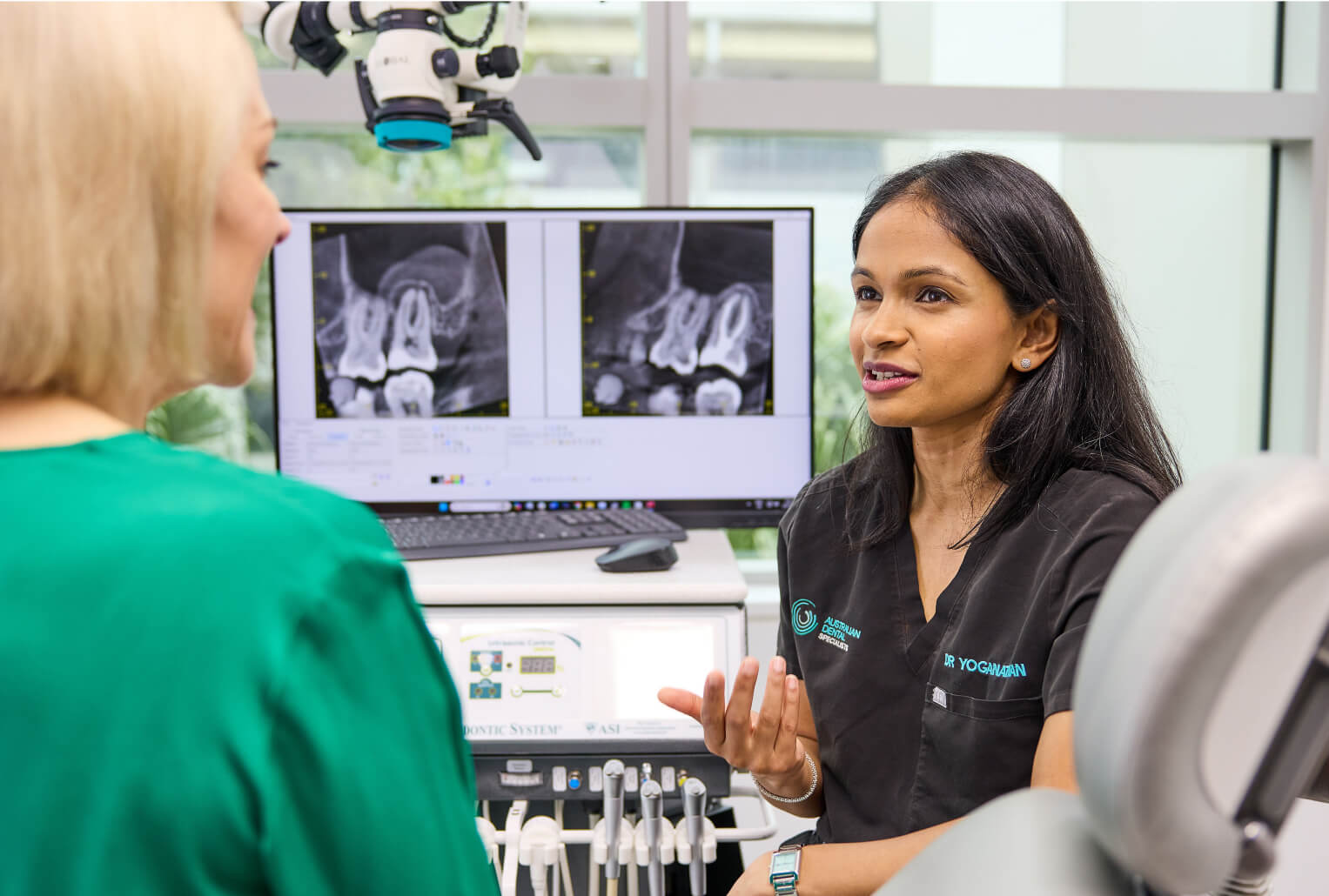
At Australian Dental Specialists, Dr Varayini Yoganathan and our endodontic team use dental operating microscopes and 3D CBCT imaging to provide the most thorough assessment possible, so you understand all your options before making a decision.
Your consultation includes a comprehensive examination with microscopic assessment, 3D CBCT imaging for detailed root and bone evaluation, clear treatment options with expected outcomes, transparent pricing with no hidden costs, and a personalised recommendation based on your specific situation.
Our specialist team welcomes patients from across North West Sydney, the Hills District, Norwest Business Park, and Greater Sydney. Your natural tooth may be more salvageable than you think — before deciding on extraction, a specialist opinion is worth getting.
General educational information only. Individual treatment outcomes vary. Always consult a qualified dental practitioner about your specific circumstances.
We offer timely appointments to ensure you receive the care you need when you need it. From endodontics to periodontal therapy, our specialists manage every aspect of your dental health with expertise and comprehensive post-operative support.
Your smile is our priority—experience the difference with our specialist care today.
© 2026 Australian Dental Specialists | Privacy
Site by Luna Digital Marketing
